Claude Certified Architect & Anthropic's 4 Certifications:Cost, Format, and How to Register (2026)
Anthropic's Claude certifications now come in four: CCAO-F, CCDV-F, CCAR-F and CCAR-P, $99 to $175, proctored by Pearson VUE. Domain weights and recommended experience for each, from the four official Exam Guides, plus a flowchart for picking one and how registration works today.
Contents
- 01Model vendors have started issuing their own credentials
- 02The four Claude certifications
- 03Which one should I take? Match the official recommended experience
- 04Free Claude certificates vs. the four paid credentials
- 05Are CCAF, CCA-F and CCAR-F the same Claude Certified Architect credential?
- 06Why four credentials at once
- 07Rules shared by all four
- 08How to read the official Exam Guides
- 09What each exam covers
- CCAO-F: most weight on judging Claude’s output
- CCDV-F: a third of the questions on applications and integration
- CCAR-F: most weight on agent architecture, every question in a scenario
- CCAR-P: weight spread out, with governance, communication and RAG added
- 10My company isn’t an Anthropic partner. Can I still take it?
- Sources
Claude certifications are Anthropic’s official professional credentials for Claude. There are four. The first, Claude Certified Architect - Foundations, launched in March 2026, and three more followed in July. All four are proctored by Pearson VUE, cost $99 to $175, earn a Credly digital badge, and stay valid for 12 months. Each has an official Exam Guide that lists the exam’s domains and what share of the questions each domain carries. None of them is the same thing as the free Claude course certificates that circulate on social media. This article covers which one to take, what each one tests, and how they differ from the free certificates.
Model vendors have started issuing their own credentials
Until recently, the best-known proctored AI certifications came from the cloud vendors: Microsoft’s Azure AI certifications, Google Cloud’s Generative AI Leader, AWS Certified AI Practitioner. They test how to use AI services on that vendor’s platform, and they cost roughly $99 to $200.
By 2026 a second kind had taken shape: the companies that build the models issuing credentials themselves. The three main model vendors are at very different stages:
Two differences are worth spelling out. What most people can get from OpenAI today proves you finished a course, not that you passed an exam. Google does run proctored exams, but its cloud division issues them, and they test using AI on Google Cloud, not the Gemini model ecosystem itself.
So far, only one model vendor runs the whole system under its own model brand, with its own exam questions, third-party proctoring and a formal way to register: Anthropic, the enterprise-focused company behind Claude.
In March 2026, Anthropic launched its first credential, Claude Certified Architect - Foundations, together with the Claude Partner Network. The announcement included a line few people noticed: “Later this year, we’ll introduce additional certifications for sellers, architects, and developers.” Four months later, part of that “later” arrived. One credential became four.
The four Claude certifications
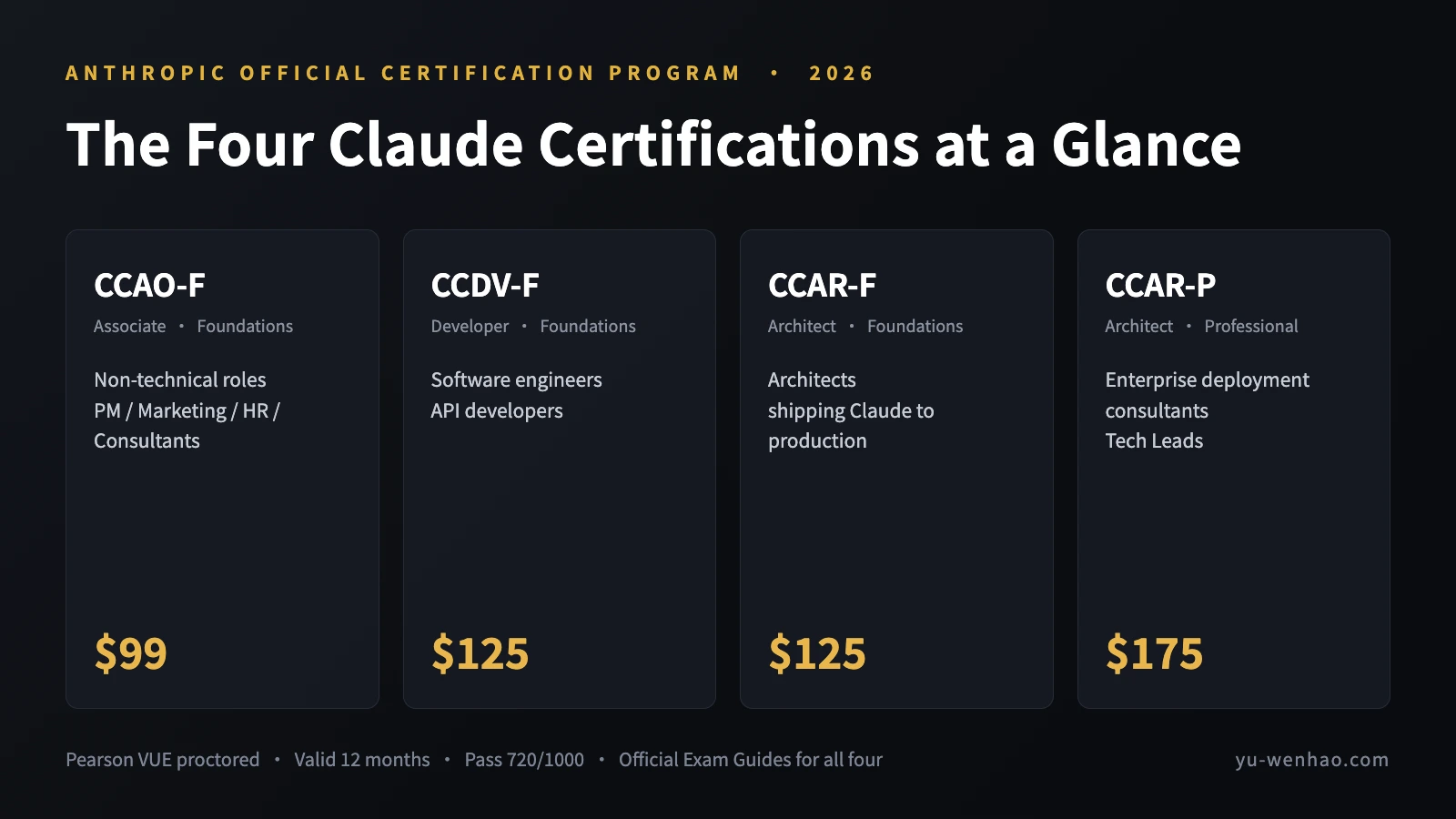
Anthropic’s program has four credentials. The details below come from the FAQ on Partner Academy, Anthropic’s learning platform for partners, the Pearson VUE page, and the four official Exam Guides:
| Credential | Questions | Recommended experience | Price | Exam Guide |
|---|---|---|---|---|
| Associate - Foundations (CCAO-F) | 60 | Uses Claude regularly at work; no coding | $99 | |
| Developer - Foundations (CCDV-F) | 53 | 1–5 years of development + 6+ months with Claude or a comparable LLM | $125 | |
| Architect - Foundations (CCAR-F) | 60 | 6+ months building with Claude (API, SDK, MCP) | $125 | |
| Architect - Professional (CCAR-P) | 63 | 3+ years of architecture or platform engineering + 6+ months with Claude or a comparable LLM in production | $175 |
Question counts and recommended experience come from the current Exam Guides (v1.0, July 2026).
Three of the four change before the end of the year: CCAO-F, CCDV-F and CCAR-P switch to new exam content on December 7 (Pearson VUE notice). If you test on or before December 6, prepare with the current version. The section on reading the Exam Guides below shows which version to use.
Which one should I take? Match the official recommended experience
The most reliable guide is the recommended experience written into each of the four Exam Guides: what the candidate Anthropic expects to just pass does day to day, and for how long. Matching your own work against that description is more accurate than going by the credential’s name.
Which Claude certification to take
Simplified from the recommended experience in the four Exam Guides, not an eligibility rule. None of the four has a prerequisite; you can register for any of them directly. Click a box to jump to that exam’s scope.
The hardest pair to tell apart is CCDV-F and CCAR-F, since both test agents and tools. CCDV-F tests the skill of writing Claude into code: its guide recommends Python or TypeScript, and a third of the questions fall under Applications and Integration, which also covers software engineering basics such as REST APIs and version control. CCAR-F tests architectural judgment and trade-offs. Its guide states that it does not test implementation details of any specific programming language or framework, apart from what configuring tools and schemas requires. Its heaviest domain is agent architecture, and Claude Code configuration has a domain of its own at 20%.
Once you’ve picked one, note that registration goes through an Anthropic partner organization; a personal account can’t register. If your company isn’t a partner, see the last section.
Free Claude certificates vs. the four paid credentials
Before going further, one mix-up you have probably already run into.
The “free Claude certificates” shared widely on social media are completion certificates from Anthropic’s official course catalog. It has more than twenty free courses, from Claude Code in Action, Introduction to Model Context Protocol and Building with the Claude API to the AI Fluency series for non-technical roles. Finish one and you get a course-completion certificate.
Those certificates are a different thing from the four Claude certifications in this article (CCAO-F, CCDV-F, CCAR-F, CCAR-P).
A course certificate records that you finished an online course. It has no proctoring, no common passing standard and no Credly badge. The four credentials are standardized exams proctored by Pearson VUE, scored on one global scale.
Social media often treats the two as the same. When you see a headline about an “Anthropic certificate”, check which kind it means.
Are CCAF, CCA-F and CCAR-F the same Claude Certified Architect credential?
If you have searched for the Architect - Foundations credential before, you have probably met three different abbreviations. They aren’t typos. Two date from the credential’s first months, one used by Anthropic and the other by most community posts and third-party write-ups; the third is the formal exam code added in July.
When Anthropic launched the credential in March 2026, the announcement used only the full name, with no formal abbreviation. Anthropic’s own follow-up communications, including an official email and the short URL clau.de/CCAF, used CCAF. Community posts and most third-party write-ups used CCA-F. You may also see it called “Anthropic Certified Architect”; it’s the same exam.
In July 2026, when the program expanded to four credentials and the exams moved to Pearson VUE, Architect - Foundations got its formal exam code: CCAR-F. The added R appears to be there to distinguish it from the Associate credential launched at the same time, CCAO-F.
All three abbreviations name the same credential at different times. For anything external-facing, such as a LinkedIn certification entry or a résumé, the current official code CCAR-F is the most precise.
Why four credentials at once
The four credentials are cut by role: one for people who don’t code, one for developers, and two for architects (foundations and professional). When Anthropic released them in July, its announcement called them “role-based certifications.”
The one most worth noticing is CCAO-F (Associate), for non-technical roles. A PM who evaluates output quality, an operations lead who improves processes, an HR manager who plans internal training: Anthropic set an exam for them too, which counts these people among those an AI adoption has to train.
The division of labor is written into the official documents. The CCAO-F Exam Guide lists knowing your limits as an Associate skill: more complex or technical work goes to a Claude Architect or Developer. The guide also states that designing enterprise architecture and building system integrations are outside this credential’s scope; they belong to the other two kinds.
In its March announcement, Anthropic said certifications for sellers would come later in the year. As of mid-November, the official list still has these four.
The division of labor in AI services work is starting to exist on paper.
Rules shared by all four
All four credentials run under one set of rules, per the Anthropic Partner Academy FAQ (the primary source) and the four Exam Guides:
From registration to badge
Every exam is proctored by Pearson VUE, online or at a test center. The passing score is 720 on a scaled range of 100 to 1,000, and passing earns a Credly digital badge.
After you pass: renewal. A credential is valid for 12 months. Before it expires, you can renew for free with a non-proctored online assessment on Partner Academy, without another Pearson VUE exam. If it lapses, you pay the full fee and retake the whole exam. All four guides state one exception: when exam content changes substantially, Anthropic may require holders to retake the full exam instead of the renewal assessment.
If you fail: waiting periods. After a first failed attempt you wait 14 days, after a second 30 days, and after a third 90 days. You can sit the same exam at most four times within 12 months, and each attempt costs the full fee again. The limits count per exam, so failing one doesn’t stop you from registering for another.
A few more rules decide whether you get into the exam and whether you get your fee back. On exam day you need a valid, government-issued photo ID; if its name doesn’t match your registration, you can’t test that day and the fee isn’t refunded. To change the name on your registration, use Update Exam Profile in your Partner Academy profile. You can do this once a year, and your name locks for a year once you confirm. If you’ve already used that yearly change and still need a correction, request it from Anthropic Certification Support. Missing a scheduled exam also forfeits the fee.
How to read the official Exam Guides
If you’re preparing seriously, read the four official Exam Guides before any third-party prep material. The PDFs download without a login. Direct links are in the table above, and the Partner Academy certifications page lists them too.
The four guides share a structure. Every exam is 120 minutes of multiple-choice questions, mixing single-answer and multiple-answer items, and each question states how many answers to pick. Start with three parts:
- Domain weights: what share of the questions each domain carries.
- Sample questions: answers and explanations included, so you can see how questions are written and how hard they are.
- The score report description: besides pass or fail and your score, the report lists your percentage correct in each domain, so a candidate who fails can see what to work on.
Which version to read depends on your exam date:
Which Exam Guide to read, by exam date
What each exam covers
The four exams have different numbers of domains: CCAO-F has 7, CCDV-F 8, CCAR-F 5 and CCAR-P 7. Every bar chart below treats 35% as a full bar, so you can compare the four directly.
CCAO-F: most weight on judging Claude’s output
CCAO-F has 60 questions across 7 domains. The heaviest is Output Evaluation and Validation at 21%, more than the 14% for prompting. This credential for non-technical roles puts the most weight on judging whether Claude’s output is right: catching hallucinations, inconsistencies and bias, and knowing when to hand the work to a human reviewer.
CCAO-F domain weights (60 questions)
Bars are scaled to 35%, the same scale for all four exams.
One way to prepare, per the guide: build your own Project, add instructions and knowledge sources, then check the output for errors and bias.
CCDV-F: a third of the questions on applications and integration
CCDV-F is the shortest of the four, at 53 questions across 8 domains. Applications and Integration alone carries 33.1%. Within that domain, the three heaviest sub-areas are Claude Application Design (8.6%), Software Engineering Foundations (7.4%) and Claude API Mechanics (6.8%).
CCDV-F domain weights (53 questions)
Bars are scaled to 35%, the same scale for all four exams.
At the other end, Claude Code is 3.1% and Eval, Testing, and Debugging is 2.6%. The exam centers on building Claude into an ordinary software project. The guide recommends having built and run at least one Claude application that uses the API, connects tools, and includes basic security and evaluation.
CCAR-F: most weight on agent architecture, every question in a scenario
CCAR-F was the first of the four, and its 60 questions are built in two layers. Five domains set what is tested; the heaviest is Agentic Architecture & Orchestration at 27%. Under each domain, the guide lists task statements describing what a candidate should be able to do.
CCAR-F domain weights (60 questions)
Bars are scaled to 35%, the same scale for all four exams.
Six scenarios set how it is tested. Questions don’t ask for definitions; they put you inside a real project: customer support agent, code generation, multi-agent research, developer productivity, CI/CD and structured data extraction. Each exam draws 4 of the 6 at random.
Here is how the two layers fit together. Say you draw the customer support agent scenario. The setup is a support system built on Claude, and the agent has four tools: look up a customer, look up an order, issue a refund, and escalate to a human. The question asks whether an action that must never go wrong, like a refund, should be blocked in code or left to a reminder in the prompt. The question is dressed as customer support, but it tests the Agentic Architecture & Orchestration domain, specifically enforcing a workflow in code.
The guide also lists what the exam leaves out: fine-tuning or training models, implementation details of embedding models and vector databases, computer use (operating a browser or desktop), and implementing the streaming API. You can set those aside while preparing.
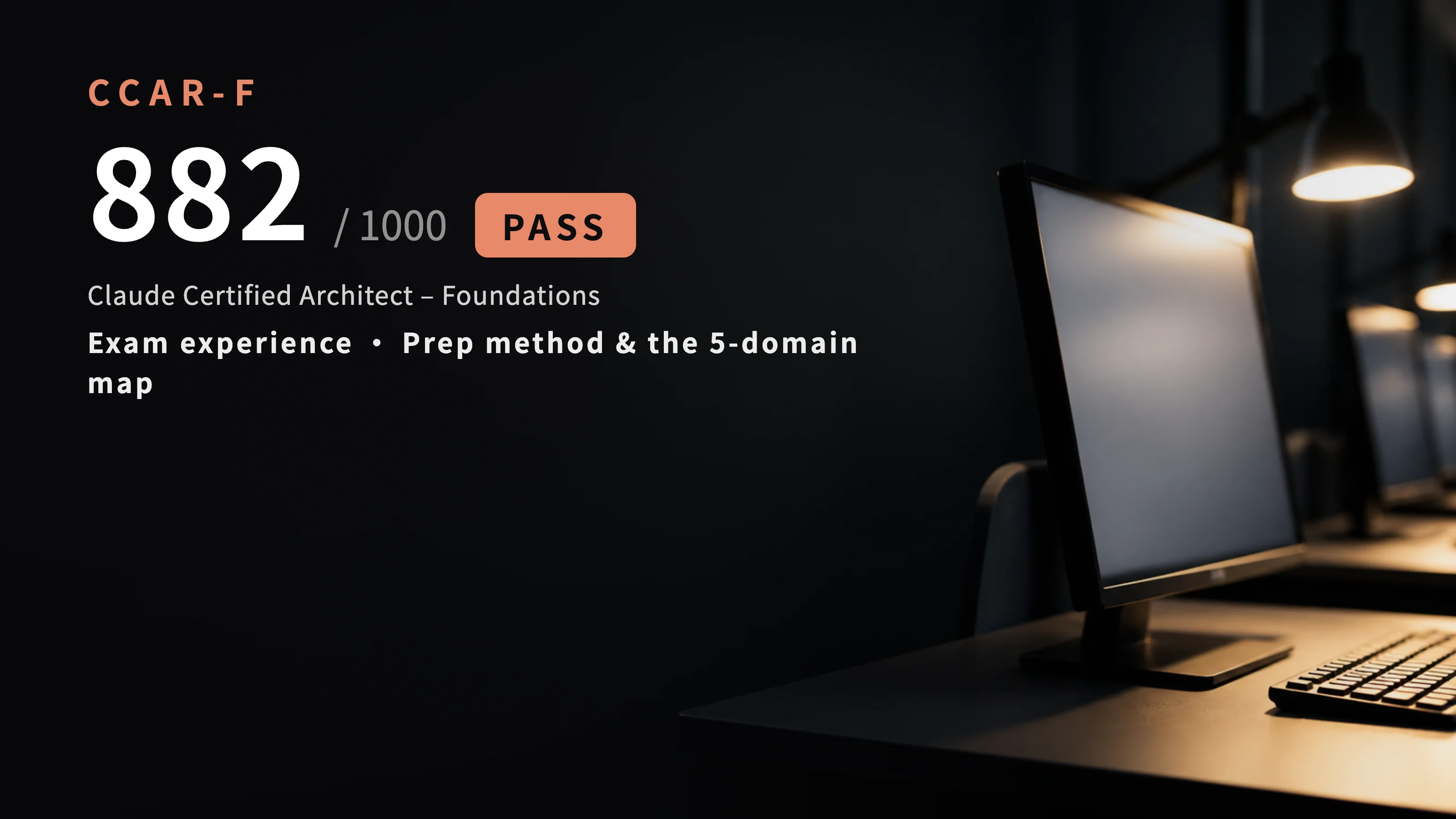
The CCAR-F guide is also much thicker, at 39 pages, with 4 hands-on exercises and 12 sample questions; the other three guides have 3 sample questions each. I took CCAR-F myself and scored 882; my prep method, domain map and test-day walkthrough are in my CCAR-F exam experience.
CCAR-P: weight spread out, with governance, communication and RAG added
CCAR-P has 63 questions across 7 domains, and it’s the only one of the four where every domain is under 20%. The heaviest, Integration, is 19%.
CCAR-P domain weights (63 questions)
Bars are scaled to 35%, the same scale for all four exams.
The difference is clearest next to CCAR-F, the other Architect credential:
The two added domains are Governance, Safety & Risk Management and Stakeholder Communication & Lifecycle Management. They cover guardrails and regulatory compliance, requirements interviews with stakeholders, and explaining architectural trade-offs. RAG sits in the Integration domain: you need to decide how documents are chunked and indexed. CCAR-P tests something closer to an architect who leads the project, who manages requirements, communication and post-launch risk on top of how the system is built.
As preparation, the guide recommends building and running at least one complete Claude solution yourself, including RAG, evaluation and observability.
My company isn’t an Anthropic partner. Can I still take it?
Yes, but you register through a partner organization. All four credentials are registered on Partner Academy and paid for when you schedule at Pearson VUE. Anthropic opens registration only to members of the Claude Partner Network, its partner program for service providers, and a personal email can’t register. If your company isn’t a partner, in practice you need an account through a partner organization. If that’s where you’re stuck, the later part of my CCAR-F exam experience explains how I can help.
Whether it’s worth taking depends on whether your clients, or the company you want to work for, use Claude. A credential’s weight ultimately comes from the real products and the real market behind it. That is why the model-vendor category is worth watching: it has only just opened.
Sources
- Anthropic: Claude Partner Network launch announcement (March 12, 2026)
- Anthropic: Four role-based certifications for the people who put Claude to work for customers (July 23, 2026)
- Anthropic Partner Academy: Certification FAQ: registration, pricing, rescheduling, validity, retake policy
- Anthropic Partner Academy: Certifications page, with all four official Exam Guides
- Anthropic: Claude Certified Associate – Foundations Exam Guide (PDF, v1.0, July 2026)
- Anthropic: Claude Certified Developer – Foundations Exam Guide (PDF, v1.0, July 2026)
- Anthropic: Claude Certified Architect – Foundations Exam Guide (PDF, v1.0, July 2026)
- Anthropic: Claude Certified Architect – Professional Exam Guide (PDF, v1.0, July 2026)
- Pearson VUE: Claude Certification Program
- Anthropic: Free course catalog (Skilljar)
- OpenAI: Certificate Courses
- Google Cloud: Generative AI Leader certification
- AWS: Certified AI Practitioner
Want to sit one of these exams but have no registration path? Leave your contact here, and I’ll reply personally.
- Questions, or something to work on together? Find me on LinkedIn ↗
FAQ
- Can individuals take a Claude certification?
- Yes, but you have to register through an Anthropic partner organization; a personal email can't register. Anthropic opens registration only to members of the Claude Partner Network, its partner program for service providers. All four credentials are registered on Partner Academy, Anthropic's partner learning platform, and paid for when you schedule the exam at Pearson VUE. If your company isn't a partner, in practice you need an account through a partner organization. If you're stuck at this step, the CCAR-F exam experience post on this site explains, near the end, where to get help.
- How much does a Claude certification cost, and how long is the exam?
- The four credentials cost $99 to $175, and every exam runs 120 minutes. CCAO-F is $99, CCDV-F and CCAR-F are $125 each, and CCAR-P is $175. Depending on the credential, an exam has 53 to 63 questions, all multiple choice with a mix of single-answer and multiple-answer items. The passing score is 720 out of 1,000 for all four, and Pearson VUE proctors them online or at a test center.
- Do I have to take the four Claude certifications in order?
- No. None of the four has a prerequisite, so you can register for any of them directly. To choose, compare your work with the recommended experience in each official Exam Guide: someone who uses Claude at work and doesn't code matches CCAO-F, and someone with 3 or more years of systems architecture or platform engineering plus 6 or more months of running Claude or a comparable LLM in production matches CCAR-P. Retake limits also count per exam, so failing one doesn't affect registering for another.
- How are Claude certifications different from Anthropic's free course certificates?
- A free certificate records that you finished an online course; the four Claude certifications are proctored, standardized exams. Anthropic's official learning platform has more than twenty free courses, and finishing one earns a completion certificate with no proctoring, no common passing standard and no Credly badge. The four certifications are proctored by Pearson VUE, scored on one global scale, and earn a Credly digital badge when you pass. When you see a headline about an 'Anthropic certificate', check which of the two it means.

WenHao Yu余文皓
Claude Certified Architect. Founder of Confluence Partners, helping companies adopt AI through consulting and training.
About →Related articles